Mon. - Friday., 09 am - 07 pm

Saturday 9:00 am – 5:30 pm

13 Windsor Dr, Orpington, BR6 6EY

01689852417

0
0
Chelsfield PharmacyChelsfield Pharmacy

Pharmacy First Service

Advanced Services

Pharmacy First Service

This webpage provides information on the Pharmacy First service, which commenced on 31st January 2024.

The service was announced as part of an an agreement setting out how the £645 million investment pledged within the Delivery plan for recovering access to primary care would be used to support community pharmacy services.

If you work in a general practice visit our Pharmacy First: Information for GP practice teams webpage

If you are a non-healthcare professional visit  Information on national pharmacy services webpage


The Pharmacy First ‘bundling’ requirements which mean pharmacy owners must be registered to provide the Hypertension Case-Finding Service and Pharmacy Contraception Service in order to receive the Pharmacy First monthly payment (when they also meet the monthly volume target) will be retained. It was previously announced that additional ‘bundling’ requirements would be introduced over time, including the provision of a minimum number of Ambulatory Blood Pressure Monitoring consultations within the HCFS and a minimum number of PCS consultations. We were able to gain agreement that these further, additional ‘bundling’ arrangements would not now be introduced.


Click on a heading below for more information

The Pharmacy First service, which commenced on 31st January 2024, represented a crucial first step in recognising and properly funding the enormous amount of healthcare advice that community pharmacies provide to the public every day and in establishing and funding community pharmacy as the first port of call for healthcare advice.

What does the service involve?

The Advanced service involves pharmacists providing advice and NHS-funded treatment, where clinically appropriate, for seven common conditions (age restrictions apply):

Consultations for these seven clinical pathways can be provided to patients presenting to the pharmacy as well as those referred electronically by NHS 111, general practices and others.

The service also incorporates the elements of  Chelsfield Pharmacist Consultation Service: minor illness consultations with a pharmacist and the supply of urgent medicines (and appliances), both following an electronic referral from NHS 111, general practices (urgent supply referrals are not allowed from general practices) and other authorised healthcare providers (i.e. patients are not able to present to the pharmacy without an electronic referral).

In the clinical pathway consultations, people with symptoms suggestive of the seven conditions will be provided with advice and will be supplied, where clinically necessary, with a prescription-only treatment under a Patient Group Direction (PGD) or in one pathway, an over-the-counter medicine (supplied under a clinical protocol), all at NHS expense.

From the autumn of 2026, pharmacist independent prescribers will be able to use their skills to complete episodes of care within the service, without the need for a PGD. However, for the time being, all pharmacists providing the service must use the PGDs and clinical protocol.

The service requirements are included in the service specification and the associated clinical pathways.

Download the service specification and clinical pathways

Download the 23 PGDs and 1 clinical protocol, which authorise the supply of medicines under Pharmacy First

Master PGD and Protocol authorisation sheet
Pharmacists working under the PGDs and protocol and an authorising manager need to sign them before their use. This master authorisation sheet can be used to sign/authorise all 23 PGDs and the one clinical protocol in one document.

Consultation room

Pharmacies must have a consultation room that will be used for the provision of the service which meets the requirements of the terms of service.

There must be IT equipment accessible within the consultation room to allow contemporaneous records of the consultations provided to be made within the NHS-assured Pharmacy First IT system (see below for further information on IT systems).


Providing the service via remote consultations

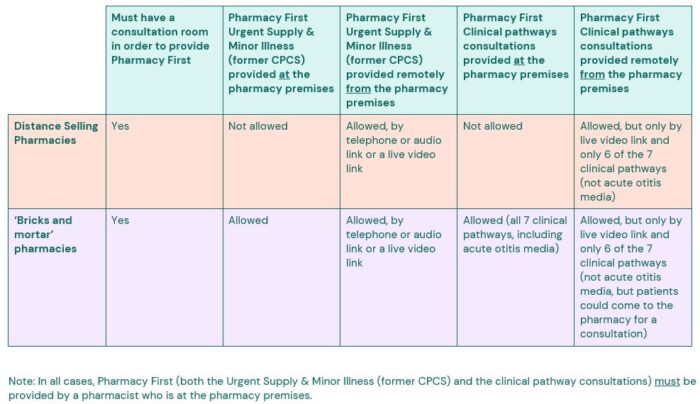
In most circumstances, the service requirements do allow remote consultations to be provided by a pharmacist who is at the pharmacy premises, but there are exceptions and specific requirements to be aware of, which are set out in the table below.

Further guidance on remote consultations

The pharmacist will also need to consider whether a remote consultation is clinically appropriate and safe to undertake.

Minor illness consultations (following referrals) and urgent medicines supply consultations (following referrals) can be undertaken via telephone/audio or video consultation by a pharmacist who is at the pharmacy.

Clinical pathways consultations can be conducted via good quality video consultation by a pharmacist who is at the pharmacy; they cannot be provided by a telephone/audio consultation.

The acute otitis media (AOM) clinical pathway requires the use of an otoscope, so that pathway cannot not be provided via a remote consultation.

Equipment

Where ear examinations are performed within the pharmacy, the pharmacist must use an otoscope. Consequently, all pharmacies providing the service (bar DSPs) must have an otoscope.

While the otoscope is the only equipment specified by the service specification, pharmacy owners may want to consider having a thermometer which can be used to measure patients’ temperatures during consultation. Tongue depressors and a small torch may also help with examination of the throat, within the sore throat pathway.


Standard Operating Procedure and Business Continuity Plan

Pharmacy owners must have a Standard Operating Procedure (SOP) for the service, which all staff participating in provision of the service must be familiar with and follow.

The SOP must include the process for escalation of any clinical and non-clinical issues identified during the provision of the service. To support this, the pharmacy must have available, signposting details for other local services, contact details for local out of hours and urgent care providers and contact details for the local Integrated Care Board (ICB).

Various pharmacy support organisations provide template SOPs which their members can personalise for use in their pharmacy. We have also produced a key contact details template for the Pharmacy First service.

While pharmacy owners should already have local safeguarding contacts, it is worth noting that the NHS England safeguarding app has a directory of safeguarding contacts for every local authority in England, searchable by region. It can be accessed via Apple iOS, Google Play – download it by visiting your device’s app store and searching for ‘NHS Safeguarding’.

Below is a summary template which can be used to record details on local GP practices referring into the Pharmacy First service, as well as details on other local pharmacies providing the service.

Pharmacy owners must also ensure the service is included in their business continuity plan.


Competency and training requirements

The pharmacy owner must ensure that pharmacists providing the service are competent to do so, including the use of an otoscope (except for DSPs) and be familiar with the clinical pathways, clinical protocol and PGDs.

The prior learning, knowledge and experience of each pharmacist will vary and consequently each individual will need to reflect on their own learning needs and identify any gaps in their knowledge which they need to fill.

The pharmacy owner must keep documentary evidence that pharmacy staff involved in the provision of the service are competent and remain up to date with regards to the specific skills and knowledge that are appropriate to their role, and to the aspects of the service they are delivering.


Tick bites/Lyme disease 
While tick bites/Lyme disease is not treatable under the Pharmacy First clinical pathway for infected insect bites, with patients needing to be signposted onwards, patients may present with a tick bite with an erythema migrans (EM) rash – also known as a bullseye rash. Therefore understanding more about the signs and symptoms should help pharmacy teams recognise the symptoms and allow them to signpost patients as appropriate.

Lyme Disease UK – Resources for pharmacy teams


Selecting an IT system

An NHS-assured Pharmacy First IT system, which meets the minimum digital requirements of the service must be used by pharmacy owners.

When choosing an IT supplier, pharmacy owners may want to refer to the NHS CPCS IT Buyers Guide.

These IT systems allow pharmacy staff to make a clinical record for the service and the data in the record will then be used by the IT system to populate a claim for payment within the NHSBSA’s MYS portal.

The transfer of data via the API will happen throughout the month, as data is entered into the IT system.

The service provisions will then be available to view in MYS from the 1st of the following month. For example, service provisions in December will be available to view in MYS on 1st January. Pharmacy owners then need to log into the MYS portal to check that the data matches the details in their IT system, and they must then submit their claim for payment.

The full dataset for the Pharmacy First service can be found in Annex B of the service specification.

The NHS-approved clinical IT system will also send messages containing a summary of the consultation to the patient’s general practice.

The following IT suppliers have NHS-assured Pharmacy First IT systems:

HxConsult (Positive Solutions)

Pharmacy Manager (Cegedim)

PharmOutcomes (Optum)

Sonar health (Sonar informatics)


Signing up to provide the service

Pharmacy owners must notify NHS England that they intend to provide the service by completion of an electronic registration through the NHS Business Services Authority’s (NHSBSA).

The pharmacy owner must ensure that the service is available throughout the pharmacy’s full opening hours (i.e. core and supplementary opening hours).

Verbal consent to receive the service must be sought from the patient and recorded in the pharmacy’s clinical record for the service

The patient must also be advised of the following information sharing that will take place:

  • The sharing of information about the service with NHS England as part of the service monitoring and evaluation.
  • The sharing of information about the service with the NHSBSA and NHS England for the purpose of contract management and as part of post-payment verification (PPV).

Annex B of the service specification includes a summary of how the data will be used by the organisations.


Clinical records

Details and the outcome of each consultation must be recorded in the pharmacy’s Pharmacy First IT system.

Pharmacy owners must adhere to defined standards of record keeping, ensuring the consultation record is made on the same day that it occurs unless exceptional circumstances apply.

Making contemporaneous records at the time of the consultation is the expectation of pharmacists providing the service. This not only meets expected professional standards, but it also supports timely provision of data to the patient’s general practice, which will also become available to view by other pharmacists providing a consultation to the patient, should they need to seek further support in due course.

Pharmacists wanting to update their knowledge of best practice record keeping can access the  Documenting in patient clinical records e-learning programme.

Where the Pharmacy First IT system is unavailable due to exceptional circumstances beyond the control of the pharmacy owner, then the consultation record must be added to the system as soon as possible after it becomes available again.

If the problem persists for longer than 3 working days, the pharmacy owner must notify their ICB of the issue.

IT suppliers have published paper-based consultation record templates for pharmacists to use in business continuity scenarios, where the IT system is temporarily unavailable, e.g. due to a system outage or loss of internet connectivity.


Accessing the patient’s general practice record

With the patient’s consent, their GP record, via GP Connect Access Record, the national care record or an alternative local clinical record for the patient, must be checked by the pharmacist during the consultation, unless there is good reason not to do so.

Use of GP Connect products requires the pharmacy owner to agree to the terms of the National Data Sharing Arrangement. By accessing GP Connect products via their NHS-assured Pharmacy First IT system, the pharmacy owner will be assumed to have read, understood, and accepted the terms of the National Data Sharing Arrangement.


Communicating with GP practices following a consultation

The pharmacy must send a notification of the provision of the service to the patient’s general practice on the day of provision or on the following working day.

Where an action is required by the general practice team (such as booking the patient in for a follow up or appointment) an action message or alternative form of an Urgent Action communication (rather than the standard post event message) must be sent to the practice.

All IT systems providing support for the service will automatically send standard post event messages containing details of the Pharmacy First consultation to the GP clinical IT system via a structured message, ready for a staff member at the practice to check and update the patient’s record.

This functionality – GP Connect: Update Record – means Pharmacy First post-event messages sent by pharmacy IT systems will appear in the general practice IT system’s workflow. The structured message will be provisionally held against the patient record and will be visible by people reviewing the record. A member of the practice team will need to review and accept the message. The structured message will then be ingested into the patient record without the need for transcribing or coding.

Messages will be available to anyone accessing the general practice record including patients themselves (e.g. by logging into their account on the NHS website or NHS App).

The structured message, which is incorporated into the patient record, will include structured data on the consultation and free text notes added by the pharmacist.

If the Pharmacy First IT system is unable to send a post-event message via GP Connect: Update Record, it will try to send the message via NHSmail, with a summary of the consultation attached as a PDF.


Resources for patients to use during or after consultations

Pharmacy First clinical pathways  – online information sources for patients (Updated Oct 2025)
When pharmacists are providing a consultation for one of the seven Pharmacy First clinical pathways, there are several leaflets/websites for patients to be pointed to which are listed in the PGDs and treatment protocol.

This resource lists all the patient-facing leaflets/website links listed in the PGDs and treatment protocol, excluding the marketing authorisation holder’s patient information leaflets (hard copies will be available within the medicine’s packaging, with copies also being available from medicines.org.uk/emc).

Hyperlinks to the leaflets/websites are listed, alongside QR codes for each leaflet/website so patients can scan this to access the leaflet/website link on their mobile phones.


Supplying medicines

If a medicine is to be supplied following an urgent medicines supply consultation or a clinical pathways consultation, the service specification requires it to be made with reasonable promptness taking into account the clinical need of the individual.

For example, supply of antivirals for the treatment of shingles for eligible patients should be made within the defined timeframes of rash onset as outlined in the clinical pathway.

The service specification notes that Distance Selling Premises (DSP) pharmacies should make necessary arrangements for a prompt delivery of the item, at no cost to the patient.

If the patient needs to be referred to another pharmacy to provide the clinical pathways consultation (e.g. due to no stock of the required medicine being available at the pharmacy or the patient of a DSP needing to receive the medicine more rapidly than the pharmacy can have it delivered), no payment will be due to the referring pharmacy.

The service specification also states that to help protect NHS resources, wherever practicable, pharmacy owners should supply the best value product to meet the clinical need of the patient.


NHS Prescription charges

The normal NHS prescription charge rules apply to medicines or appliances supplied under the service, whether via the urgent medicines supply part of the service or the clinical pathways.

The Pharmacy First IT system will print off a FP10DT EPS dispensing token and the patient should complete the relevant parts of the reverse of the form to claim exemption from the prescription charge or to indicate they have paid the NHS prescription charge.

The printed FP10DT EPS dispensing token must include the following information:

  • Full name, address and date of birth of the patient
  • Patient’s NHS number (where they have one)
  • Name, strength, and form of medicines requested (using DM+D name or shortened DM+D name)
  • The quantity supplied
  • Date of supply
  • Name and address of patient’s GP (for those who are registered with one)
  • Referral ID number (if the patient was referred)

Where medicines or appliances are supplied as part of an Urgent Medicines Supply consultation, the completed dispensing tokens should be sent to the NHSBSA as part of the month-end submission, clearly separated within the batch and marked ‘PF UMS’.

Similarly, where medicines are supplied as part of a Clinical Pathway consultation,  the completed dispensing tokens should be sent to the NHSBSA as part of the month-end submission, clearly separated within the batch and marked ‘PF CP’.


Temporary pharmacy closures

In the event of a temporary closure, pharmacy owners must ensure the elements of their business continuity plan related to the service are activated and the service is temporarily withdrawn.

They must inform the NHS 111 provider and local IUC CAS of the temporary withdrawal by calling the NHS Directory of Services Provider and Commissioner Helpline (0300 0200 363) as soon as possible to stop referrals being made to the pharmacy.

GP practices and UEC settings within the pharmacy’s primary care network should also be contacted to prevent them making further direct referrals.

The ICB must also be informed by the pharmacy owner.


Withdrawal from the Pharmacy First service

If having registered to provide the Pharmacy First service, a pharmacy owner wishes to stop providing the service, they must notify NHS England that they are no longer going to provide the service via the MYS platform, giving at least 30 days’ notice prior to the cessation of the service. The pharmacy owner may be asked for their reason for withdrawal from the service.

After de-registering from the service on the MYS portal, pharmacy owners will not be able to re-register for one month from the final day of their 30 day’s notice. After the one month period has passed, pharmacy owners can re-register for the service via the MYS portal.

Distance selling premises (DSP) pharmacies can provide the Pharmacy First service but there are some limitations on how the service is provided from a DSP with regards to the clinical pathway strand of the service:

  • DSPs cannot provide consultations face-to-face, with the patient being present at the pharmacy premises.
  • DSPs are limited to providing six of the seven clinical pathways consultations. The acute otitis media pathway is excluded as it requires otoscopic examination of the patient’s ear and DSPs cannot provide this type of consultation with the patient being present at the pharmacy premises.
  • If the patient needs to be referred to another pharmacy due to the patient requiring the medicine more rapidly than the DSP can have it delivered or if the patient needs to be referred to another pharmacy for the acute otitis media pathway, DSPs cannot claim a consultation fee for this.

Other important points to note are:

  • DSPs still need to have a consultation room which meets the requirements in the Terms of Service in order to provide the service. Having a consultation room is a prerequisite for the provision of the Pharmacy First service.
  • Remote clinical pathway consultations must be carried out by a pharmacist, at the pharmacy premises, via a good quality video consultation rather than by phone. This is because the clinical pathways will often require the pharmacist to examine the patient (e.g. a rash) or examine a sample of urine, in the case of the UTI pathway. The service specification requires a live video link of sufficient quality to be used to carry out an examination, as part of the consultation. This also applies to bricks and mortar pharmacies who are providing remote clinical pathway consultations.
  • The service specification notes that DSPs should make necessary arrangements for a prompt delivery of a medicine or appliance provided as part of the service, at no cost to the patient.

The various options for providing consultations are set out in the table below.

If the Pharmacy First service is to deliver the maximum possible benefit to patients, the NHS and community pharmacies, it is important that there is a strong relationship between community pharmacies and local general practices.

Such strong local relationships will give confidence to general practice teams to make referrals to the Pharmacy First  wherever appropriate for patients.

We all know achieving long-term changes in practice can take time and consequently the work to embed referrals from general practice to Pharmacy First will in most cases need to be sustained over several months or even years.

To support pharmacy owners, their teams and LPCs to keep engaging with local general practice colleagues, we have a range of resources available:

Pharmacy First checklist – Promoting the service to your GP practice
This checklist provides suggested actions that pharmacy owners and their teams can choose to undertake to help promote the Pharmacy First service to their local GP practice team.

An email/letter introducing the Pharmacy First service.

A three-page briefing introducing the service including questions and answers for GP practice teams.

PowerPoint presentation aimed at GP practice teams
A template presentation on the service that can be used by pharmacy owners or members of their team to present to GP practice teams, for example, at a practice meeting.

PowerPoint presentation aimed at patients
A template presentation on the service that can be used to present at events such as Patient Participation Group meetings at GP practices.

A template presentation on the service that can be used by LPCs to present to Local Medical Committees and general practice colleagues.

Template copy for websites or newsletters aimed at the public
This document contains content to promote the service to the public on GP practice websites or in their patient newsletter.

LPCs and pharmacy teams are encouraged to share the below animation and infographic with local GP practices, LMCs, PCNs and ICBs to improve understanding and engagement with the GP electronic referral pathway into the Pharmacy First service in their areas.

Watch the animation:

Pharmacy First: What GPs need to know infographic

Download this folder that contains the following resources:

  • Clip 1: Introducing the service
  • Clip 2: How the service works
  • Clip 3: The value of the service
  • Screenshots
  • Social media tiles
  • Suggested tweets/posts

We also have a page on our website aimed at GPs and their teams: Visit the Pharmacy First: Information for GPs webpage.

We have developed a range of materials including posters, social media assets and an animation which pharmacy owners can use to promote the service to patients.

Our shared folder (link below) allows you to download the latest versions of the following resources:

  • Posters for display within pharmacies and for more general use (e.g. in general practice waiting rooms);
  • Social media tiles and suggested social media posts about Pharmacy First;
  • Videos and digital screen graphics;
  • Small flyers about Pharmacy First; and
  • Template local press release for Pharmacy First launch.

Patient-facing website

There is a separate page for each of the services, providing patients with information about the individual services and directing them to the NHS website to find a pharmacy that offers the service.

This website can be used by other healthcare providers, such as GP practices, and by Local Pharmaceutical Committees (LPCs) to provide information on these services and direct patients to pharmacies in England that offer them.

Read more about the website and view resources to promote this


Animation for patients

Our animation for patients provides clear and concise information about the Pharmacy First service, highlighting the seven conditions and the eligible age ranges within the clinical pathways consultations and explaining how patients can access those.

Pharmacy owners and their teams can use the animation to communicate the benefits and scope of the Pharmacy First service to their patients. For example, the animation can be linked to in pharmacy social media content and you can download a copy to play on digital screens in pharmacies. Similarly, general practices could be encouraged to use the animation on digital screens in their practice waiting areas.

Open this folder to download the following resources: 

  • Full animation
  • Full animation with subtitles
  • Clip 1: About the service and how it works
  • Clip 2: The value of the service
  • Social media cards
  • Suggested tweets/posts

We have incorporated all of the above resources into a Pharmacy First checklist so pharmacy owners can work through the checklist to see if there are any additional activities that they or their teams could undertake to promote the service to the public:

NHS England resources

The downloadable campaign materials are available on the Department of Health and Social Care’s Campaign Resource Centre website and include:

  • A campaign toolkit;
  • Social assets; and
  • Posters.
Consultation fees

Pharmacies are paid the following consultation fees:

Minor illness consultations £17

Clinical Pathway consultations £17

Urgent supply consultations £15

There are many different scenarios which can occur within the service, so to help pharmacy owners and their teams know when you can make a claim for a payment, we have published a resource to assist with this. It lists the different scenarios, whether you need to make an entry in your Pharmacy First IT system for that scenario and whether you can claim payment:


Monthly fixed payment

In addition to the consultation fee, a monthly fixed payment of either £500 or £1,000 will be paid to pharmacy owners who:

  • meet minimum activity thresholds of clinical pathways consultations; and
  • who are registered to provide the Pharmacy Contraception Service (PCS) and the Hypertension Case-Finding Service (HCFS) – these are known as the ‘bundling’ requirements.

Only clinical pathway consultations that cross the gateway point and reach an outcome set out in the clinical pathway (without onward referral to another pharmacy), count towards meeting the monthly minimum number of consultations for the monthly fixed payment.

  • £500 for those providing 20-29 Clinical pathways consultations within a month; and
  • £1000 for those pharmacies that provide 30 or more Clinical pathways consultations within a month.

As DSP pharmacies cannot provide the HCFS on their pharmacy premises, only registration to provide the PCS is a ‘bundling’ requirement for that type of pharmacy.

It was previously announced that additional ‘bundling’ requirements would be introduced over time, including the provision of a minimum number of Ambulatory Blood Pressure Monitoring consultations within the HCFS and a minimum number of PCS consultations. In the 2026/27 negotiations with DHSC and NHS England, we were able to gain their agreement that these further, additional ‘bundling’ arrangements would not be introduced.


Caps on the provision of Pharmacy First clinical pathways consultations

To manage spending on clinical pathways consultations, caps on their provision apply to all pharmacies providing the service. Pharmacies have a monthly allocation which is updated each month to reflect their actual delivery of the service. Any activity above the monthly cap will not receive the £17 per consultation fee.

The Pharmacy First Clinical Pathways band assignments and monthly caps are published each month on the NHSBSA website.

If a pharmacy’s ODS code is not included in the list, the pharmacy is automatically considered to be in Band 1 (the lowest band).

When independent prescribing is added to the Pharmacy First service in autumn 2026, the capping mechanism will be extended to introduce a cap for IP consultations, giving two caps within each band: one applicable to pharmacies signed up to provide prescribing services, and one for those who are not.


Claiming payments

Consultation data from the pharmacy owner’s IT system will be submitted to the MYS portal via an application programming interface and it will be used by the NHSBSA to populate a payment claim.

The pharmacy owner needs to review this payment claim within the MYS portal and then submit it by the 5th day of the month following the month in which the chargeable activity was provided.

Where one or more bank holidays occur within the first five days of the following month, claims for payment should be submitted by the 6th of that month.

Late payment claim submissions will only be accepted if they are made by the final day of the month following the month in which the Pharmacy First consultation was conducted. For example, claims for consultations provided in June 2026 will need to be submitted by 11.59pm on 31st July 2026.

Later claims will not be paid, unless the submission of a claim was delayed by IT issues outside the pharmacy owner’s control (such as issues with the NHS approved API system used by the pharmacy owner or with the MYS portal). Such claims will be accepted outside the usual grace period within twelve months of the date by which the claim should have been submitted. This is subject to the NHSBSA receiving evidence of the IT issue, and only if investigation finds that the evidence demonstrates that the IT issue was outside the control of the pharmacy owner, and it delayed the claim submission.

In the 2026/27 CPCF negotiations, we gained agreement from DHSC and NHS England that a later claim period would be re-introduced for the Pharmacy First service. This will be introduced later in 2026  and will allow a 2-month late claim window, giving pharmacy owners a total of 3 months to claim. We will notify pharmacy owners when the implementation date is confirmed.


Payment claims may be investigated if provision is outside of service requirements

Where payment claims are submitted and the data provided indicates the service was not provided in accordance with the appropriate Patient Group Direction (PGD) or the service specification, the payments may be withheld by the NHSBSA while the claims are investigated. Examples of this include:

  •  If an excessive quantity of medicine has been supplied, for example, outside that stipulated in the PGD;
  • A patient was outside the age range of the PGD, for example, a woman aged 65 or over for an Uncomplicated urinary tract infection; or
  • An acute otitis media pathway was provided by a distance selling pharmacy.

Following the outcome of the investigation, payments will only be made to pharmacy owners if they provide sufficient evidence to show that the supply was in accordance with the PGD and service specification.

At Chelsfield Pharmacy, we are always keen to hear from pharmacy owners and their teams about how the provision of national pharmacy services is going, be that niggles with the way services are commissioned, a success story you want to share or something else. 

Please click on the link below to share a success story where you have helped achieve a good outcome for a patient following a consultation for a national pharmacy service or to provide feedback on one of the services. 

Cart
  • Your cart is empty Browse Shop